
In This Article
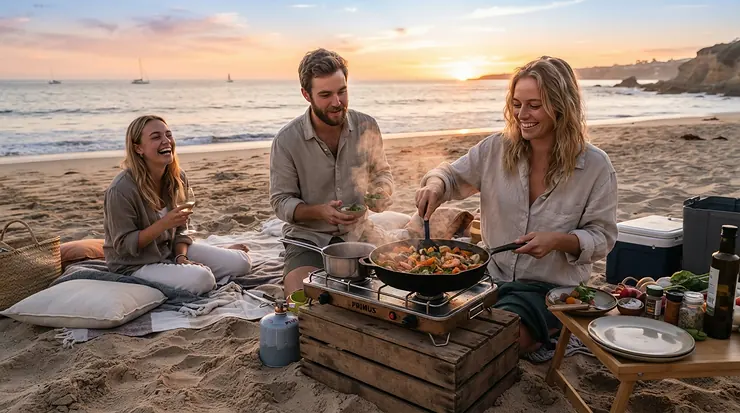
A two burner propane stove with wind guards for windy beaches is a camp cooker with two independently controlled burners, fed by propane, and fitted with fixed or folding panels that shield the flame from crosswinds. The guards keep the flame lit and the heat under your pot instead of drifting down the shoreline.
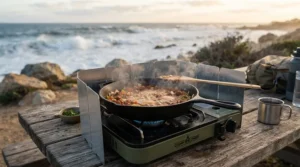
Beach wind is the great equalizer. It doesn’t care that you packed the good steaks or that the kids have been “starving” since ten a.m. It slides off the water, crosses an open stretch of sand with nothing to slow it down, and heads straight for your flame. Anyone who has watched a pot of pasta water sulk at lukewarm while the breeze rearranges a blue flame knows the feeling.
The good news is that this problem is solvable. Propane suits shoreline cooking because its boiling point sits near −42°C, according to Wikipedia’s propane entry. It keeps vaporizing on cold, damp mornings when butane canisters get sulky. Pair that fuel with a stove that has proper guards and dinner stops being a gamble.
This guide compares seven real, widely sold models, from the budget-friendly Coleman Classic Propane 2-Burner to the fold-flat Jetboil Genesis Basecamp. Every spec is translated into what it means when gusts hit at 3 p.m. You’ll also find setup tricks, a problem-and-solution guide, safety context, and honest notes on where reviewers disagree. Prices are ranges as of fall 2026, so check current price before you buy.
Quick Comparison: Which Wind-Ready Two-Burner Fits Your Beach Trip?
| Stove | Wind Protection Style | Total BTU | Price Range | Best For |
|---|---|---|---|---|
| Camp Chef Everest 2X | Lid folds into a three-sided screen | 40,000 | $135-$230 | Best overall beach pick for 3-5 people |
| Camp Chef Explorer | Three-sided screen on a tall stand | 60,000 | $160-$180 | Big groups and griddle cooking |
| Coleman Classic Propane 2-Burner | Adjustable side panels | 20,000 | $80-$100 | Budget-conscious weekend campers |
| Eureka Ignite Plus | Wind-blocking wings plus raised grate | 20,000 | $95-$190 | Cooks who use two 12-inch pans |
| Jetboil Genesis Basecamp | Thin clip-in screen | 20,000 | Mid-$300s | Small vehicles and tight storage |
Reading across the rows, the Camp Chef Everest 2X pairs the most complete built-in screen with strong output, which is why it keeps topping independent roundups. The Coleman Classic Propane 2-Burner is the sensible budget buy, though its lower total BTU means slower boils when a stiff breeze is stealing heat. Buyers who rank storage size above wind performance should note that the Jetboil Genesis Basecamp trades screen coverage for a remarkably compact fold-down body.
💬 Just one click — help others make better buying decisions too!😊
Top 7 Two Burner Propane Stove With Wind Guards for Windy Beaches: Expert Analysis
Each pick below gets the same treatment: what the spec sheet says, what it means on sand, and where real reviewers push back. Everything here is analysis built from published specs and aggregated review sentiment, not hands-on testing claims.
1. Camp Chef Everest 2X — lid doubles as a three-sided windscreen
The lid on the Camp Chef Everest 2X folds open into a three-sided windscreen. The shield rides with the stove and never ends up buried in a dune. Underneath sit two 20,000 BTU cast-aluminum burners and a 215-square-inch cooktop. On a beach that output is reserve capacity: wind steals heat from the pot, and extra power lets you keep boiling anyway. Matchless ignition matters more than it sounds, because fumbling with a lighter behind a screen is a special kind of misery.
In one independent test that averaged a windy and a calm boil, it finished a liter in roughly 3 minutes 21 seconds, the quickest in its group. That fan only simulated a gentle 2-4 mph breeze, so real shoreline gusts demand a sheltered setup. Older units with certain regulator date codes were part of a 2020 CPSC recall, so check the label if you buy secondhand. Reviewers consistently praise its wind resistance and fine simmer control. The recurring gripes are weight and a one-year warranty.
Pros:
- ✅ Built-in lid screen never gets lost
- ✅ Fast boils with fine simmer control
- ✅ Matchless ignition saves fumbling with lighters
Cons:
- ❌ Heavier than most tabletop rivals
- ❌ Only a one-year warranty
Expect a $135-$230 range depending on seller and variant. It’s the best value here if you cook for three or more people regularly.
2. Camp Chef Explorer — most firepower for group beach cooking
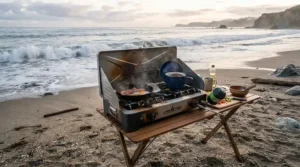
The Camp Chef Explorer is for people who treat “dinner for six” as a casual Tuesday. Two 30,000 BTU cast-aluminum burners sit on a freestanding frame with detachable legs, a three-sided windscreen, and a 14-by-32-inch cooking area. In practice that means a big griddle or two stockpots fit comfortably, and all that output can overpower the heat the wind carries away.
Here’s the catch. The stand is about 29 inches tall, which spares your back but puts the burners farther from your pans. Independent testers at OutdoorGearLab noted that large freestanding stoves all struggled with wind to some degree for exactly this reason. Low flames are prone to getting snuffed, and with no auto-ignition you’d shift cookware to relight. My read: on an open beach, park it behind a car or dune and cook at medium rather than minimum. The kit includes a three-foot hose and regulator for a bulk tank, and it accepts most 14-inch Camp Chef accessories. Retail ratings land around 4.4-4.7, with buyers praising durability and flame power.
Pros:
- ✅ 60,000 BTU handles big group meals
- ✅ Detachable legs and accessory compatibility
- ✅ Hose and regulator included for bulk tanks
Cons:
- ❌ Tall stand exposes low flames to gusts
- ❌ Heavy at roughly 30 pounds
Plan on a $160-$180 range. It’s worth it only if your beach trips regularly feed five or more.
3. Coleman Classic Propane 2-Burner — adjustable WindBlock panels on a budget
The side panels on the Coleman Classic Propane 2-Burner adjust and fold, so you can open them for more airflow or tuck them tight against a breeze. You get 20,000 total BTU, a PerfectFlow regulator that keeps output consistent as the bottle chills, and a cooktop that fits a 12-inch and a 10-inch pan at once. The match-light start is old school and simple.
What does that mean at the shore? It’s a stove built for an unhurried breakfast-and-dinner rhythm, not speed. Its power is modest, so in sustained wind expect slower boils than 40,000 BTU rivals. Keep lids on your pots and you’ll recover most of the gap. The adjustable flaps are genuinely handy when wind direction swings through an afternoon. Ratings sit near 4.7-4.8 at major retailers, with thousands of reviews, and several long-term owners describe years of service. One recurring tip from reviewers is to support the rigid regulator line, since a hanging bottle can bend it.
Pros:
- ✅ Adjustable panels fit varied pan sizes
- ✅ Simple, durable match-light design
- ✅ Lowest entry price in this lineup
Cons:
- ❌ No push-button igniter, so keep a lighter handy
- ❌ Slower boils in strong wind than higher-BTU models
Expect an $80-$100 range, which makes it the value verdict winner for casual weekenders.
4. Coleman Triton 2-Burner — easy-carry value with dual wind guards
The Coleman Triton 2-Burner pairs two adjustable burners with two wind guards in a slim body that has a built-in carry handle. At 22,000 total BTU it edges past the Coleman Classic Propane 2-Burner, and roundups list about an hour of burn time on high from a 16-ounce bottle. For a couple cooking two modest meals a day, one bottle plus a spare goes a long way.
The guards are the weak spot to plan around. One reviewer found the wind flaps easy to assemble but wished they were larger, so on an open beach add a cooler, car door, or tarp as a second line of defense. The removable aluminized-steel surface and grate make cleanup quick, which matters when sand gets everywhere. If you want a push-button igniter, the Coleman Triton+ InstaStart costs roughly $20 more according to one review. Retail ratings run 4.3-4.7 depending on the site, with owners praising reliability and the most common complaint being the base model’s lack of a built-in igniter.
Pros:
- ✅ Slim body with built-in carry handle
- ✅ Two adjustable burners with dual wind guards
- ✅ Removable grate cleans up quickly
Cons:
- ❌ Wind flaps are on the small side
- ❌ Base model lacks a push-button igniter
Plan on an $80-$120 range. It’s a strong value if you add your own windbreak.
5. Eureka Ignite Plus — widest burner spacing for 12-inch pans
The burners on the Eureka Ignite Plus are spaced to hold two 12-inch pans without elbowing each other, which is rarer than it should be. A raised grate leaves an open airflow path to the flame, while wind-blocking wings stand guard on the sides. You get two 10,000 BTU burners, a push-button igniter, and adjustable rubber feet that help on lumpy sand.
OutdoorGearLab found the windscreen gave reasonable protection, which helped it post above-average fuel efficiency and a roughly 5 minute 30 second average boil in its wind-and-calm tests. That’s middle of the road, not blazing, but the geometry means less heat leaks around your pans. It weighs about 12 pounds. Sentiment is warm but not unanimous: many owners love the compact size and ease of use, while others report units arriving damaged or missing parts. Availability also varies, since some retailers list it as discontinued, so verify stock before you plan a trip around it.
Pros:
- ✅ Push-button ignition lights quickly
- ✅ Fits two 12-inch pans comfortably
- ✅ Adjustable feet steady uneven ground
Cons:
- ❌ Some retailers list it as discontinued
- ❌ Reviews mention damaged or missing parts
Expect a $95-$190 range depending on the seller. It’s a good value at the lower end of that range, provided the unit arrives intact.
6. Jetboil Genesis Basecamp — most compact fold-down two-burner
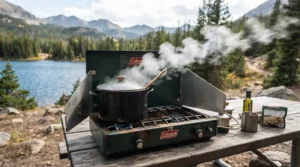
The Jetboil Genesis Basecamp folds into a cylinder roughly 10.3 by 7.2 inches and weighs just over nine pounds, making it the most compact and lightweight two-burner in OutdoorGearLab’s group. Two 10,000 BTU burners, auto-ignition, and four-turn dials deliver some of the best simmer control reviewers have seen. If your trunk is a game of Tetris, this stove wins the packing round.
Now the awkward part. Reviewers disagree about wind. Outdoor Life named it a top pick for wind in a fan test, while OutdoorGearLab and BetterTrail rated its wind protection as below average and a major drawback, with some buyers calling the screen flimsy. That split may reflect test setups, but the safe interpretation is that it needs help: bring your own windbreak. It also expands with a satellite burner for a third cooking zone.
Pros:
- ✅ Folds into a compact cylinder
- ✅ Four-turn dials give superb simmer control
- ✅ Auto-ignition plus expandable third burner
Cons:
- ❌ Reviewers disagree on wind performance
- ❌ Premium price for modest 10,000 BTU burners
It sits in the mid-$300s, so you’re paying for packability rather than raw wind-fighting. Worth it for van life, overkill for most.
7. Coleman Cascade Classic — most fuel-efficient tabletop in one major test
The wind shields on the Coleman Cascade Classic slot into the stove body using metal tabs with several adjustment notches, so you can raise or lower them to suit your cookware. It delivers 20,000 total BTU from two 10,000 BTU burners, a pressure regulator for steady output, rotary matchless ignition, and room for a 12-inch and 10-inch pan. It weighs just under 12 pounds.
OutdoorGearLab rated it the most fuel-efficient tabletop in its review, with excellent simmer control, but called it a slow boiler (about 6 minutes 39 seconds averaged across windy and calm tests) with slightly below-average wind resistance. BetterTrail logged a 6-minute-plus boil on a breezy day. So: choose it for fuel thrift and gentle cooking, and accept patience on windy days. Retail ratings run 4.5-4.7, though a few owners report a stubborn igniter on one burner or wish the materials felt sturdier.
Pros:
- ✅ Very fuel-efficient in independent testing
- ✅ Rotary matchless ignition
- ✅ Excellent simmer control
Cons:
- ❌ Slow boils in breezy conditions
- ❌ Some owners report igniter and material complaints
Expect a $90-$130 range. It’s a fair deal for patient cooks who simmer more than they sear.
Here’s the full side-by-side. Use it to narrow your shortlist before you dig into the details.
| Stove | Total BTU | Wind Protection | Ignition | Price Range | Best For |
|---|---|---|---|---|---|
| Camp Chef Everest 2X | 40,000 | Lid becomes three-sided screen | Matchless | $135-$230 | All-round beach cooking |
| Camp Chef Explorer | 60,000 | Three-sided screen, tall stand | Manual | $160-$180 | Crowds and griddles |
| Coleman Classic Propane 2-Burner | 20,000 | Adjustable panels | Match-light | $80-$100 | Budget weekends |
| Coleman Triton 2-Burner | 22,000 | Two small guards | Match-light | $80-$120 | Easy-carry value |
| Eureka Ignite Plus | 20,000 | Wings plus raised grate | Push-button | $95-$190 | Large pans |
| Jetboil Genesis Basecamp | 20,000 | Thin clip-in screen | Auto | Mid-$300s | Compact storage |
| Coleman Cascade Classic | 20,000 | Slot-in adjustable shields | Rotary matchless | $90-$130 | Fuel-sipping simmering |
The spread tells a story: BTU alone doesn’t predict beach success, because the Eureka Ignite Plus and Coleman Cascade Classic share a 20,000 BTU class yet boiled at different speeds in independent tests. The Coleman Classic Propane 2-Burner costs roughly a quarter of the Jetboil Genesis Basecamp and offers more screen coverage, so budget buyers lose little on wind protection. The Camp Chef Explorer justifies its higher fuel burn only if you cook for crowds.
✨ Don’t Miss These Exclusive Deals!
🔍 Take your beach cooking to the next level with these carefully selected stoves. Click on any highlighted item to check current pricing and availability. These tools will help you serve hot, windproof meals your whole crew will love!
How to Choose a Two Burner Propane Stove With Wind Guards for Windy Beaches
Use these six steps in order. Each one narrows the field based on what actually fails on sand.
- Match BTU to your crew. For two people, 20,000 total BTU covers most meals. For groups of four or more, 40,000 or higher keeps boils reasonable when wind steals heat.
- Judge the guard design, not just its existence. A screen should cover three sides and rise to pot height. Built-in lid screens, like the one on the Camp Chef Everest 2X, can’t be forgotten at home.
- Read how wind was tested. Independent reviewers such as OutdoorGearLab time a one-liter boil with and without a box fan on low. That’s roughly a 2-4 mph breeze, much milder than many shorelines, so treat results as relative rankings.
- Insist on a regulated flame. A pressure regulator keeps output steady as the bottle chills and empties.
- Pick ignition for relights. Push-button or auto-ignition lets you relight quickly after a gust. Match-light designs like the Coleman Triton 2-Burner work, but you’ll be hunting a lighter.
- Check fuel hookups, warranty, and recalls. A bulk-tank hose adapter saves money long term, and a quick CPSC lookup protects you from known defects.
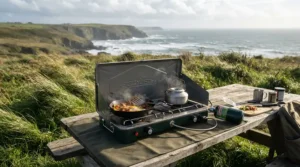
Windproof Two Burner Camp Stove for Coastal Camping: What Beach Wind Really Does
Let’s retire the word “windproof” for a moment. No stove is truly windproof; the best ones are wind-tolerant. Understanding why helps you pick and position the right model.
Coastal wind does three nasty things at once. It can blow out the flame, especially at low settings. It strips heat from your pot by moving air across the metal, so even a lit flame cooks slowly. And it pushes the flame sideways, heating one edge of the pan while the other stays cold.
A good windproof two burner camp stove for coastal camping tackles all three: guards that stop crosswinds, burners strong enough to compensate for heat loss, and a regulator that keeps the flame steady. The Camp Chef Everest 2X attacks the problem with a screen plus 40,000 BTU of muscle. The Coleman Classic Propane 2-Burner leans on adjustable panels and a thrifty approach.
Placement does half the work. Set the stove so the wind hits its closed back, use a vehicle or dune as a windbreak, and keep the stove low, since gusts accelerate over open ground. Salt-laden air is another coastal factor: it’s harder on bare metal over time, which is why a quick rinse and dry after each trip matters. Test conditions rarely include sand, salt, or gusts, so build in margin rather than trusting a single boil-time number.
Two Burner Stove With Removable Windscreen Panels: Convenience or Compromise?
A two burner stove with removable windscreen panels offers flexibility that fixed screens can’t. You can raise the panels for tall pots, lower them for airflow, or take them off to wipe away sand. The Coleman Cascade Classic uses notched tabs for this, and the Coleman Classic Propane 2-Burner lets its side flaps open and fold.
There’s a trade-off. Removable parts can be lost, bent, or misaligned, and on a windy beach a loose panel is a kite. The Coleman Triton 2-Burner‘s flaps assemble easily, but one reviewer wanted them bigger. The Jetboil Genesis Basecamp‘s clip-in screen draws repeated complaints about feeling flimsy.
Fixed or lid-integrated screens, like the Camp Chef Everest 2X design, are harder to lose and usually stiffer. The compromise is less flexibility with big pans. Some buyers add aftermarket freestanding windscreens, and a few reviewers note these shift in light gusts unless secured. If you buy a stove with removable panels, test how firmly they lock before you leave home, and store them in the same bag as the stove.
Baffled Burners vs Wind Guard Panels: Which Protection Actually Works?
These two ideas get lumped together, but they solve different problems. Baffled burners use shrouds, plates, or burner-head geometry to shelter the flame at its source. Wind guard panels are external walls that interrupt crosswinds before they reach the burner. Spec sheets for some compact stoves list wind baffles, but manufacturers rarely publish detailed designs, so most evidence comes from comparative testing.
My practical take: panels do the heavy lifting, and burner design fine-tunes. Panels cut wind speed over a wide area, so they protect both flame and pot. Baffled burners help keep a low flame alive, but they can’t stop wind from cooling the pot.
Geometry matters too. The Eureka Ignite Plus uses a raised grate that leaves open airflow to the flame while wings block crosswinds, an approach reviewers called effective. The Camp Chef Explorer shows the opposite lesson: its burners sit farther from cookware on a tall frame, and testers found that wind creeping in could snuff low flames.
When comparing stoves, ask three questions. How tall is the screen relative to your pots? How close is the burner to the pan? And does the manufacturer use a regulator to keep output consistent? A stove with excellent panels but poor burner geometry may still disappoint, which is why independent boil tests beat marketing copy.
| Option | Wind handling on a beach | Capacity | Cold-morning reliability | Best For |
|---|---|---|---|---|
| Two burner propane stove with guards | Strong when panels are adjustable | Two pots at once | Reliable in chilly air | Meals for 2-6 |
| Single-burner canister stove | Exposed unless shielded | One pot | Varies by fuel blend | Solo trips |
| Open fire or charcoal | Wind feeds flames unpredictably | Large | Slow to start | Ambience, not speed |
| Butane tabletop stove | Prone to flame-out | One or two pots | Weaker when cold | Mild-weather picnics |
The table shows why two-burner propane remains the beach default: it handles two pots, tolerates chilly mornings, and responds well to panels. Butane’s higher boiling point, roughly −0.5°C versus propane’s −42°C, is why it fades first on cool, damp shores. Open fire has charm, but wind makes it harder to control and sometimes restricted.
Flame Stability in Gusts: Regulators, Cold Propane, and Low-Flame Cooking
Flame stability in gusts depends on three things: pressure regulation, stove geometry, and technique. Regulators matter most. A PerfectFlow-style regulator holds output steady even as the bottle chills during long cooks, something cheaper stoves struggle with.
Cold itself isn’t the villain. Propane’s low boiling point means it keeps vaporizing in cool weather. The issue is draw-down: a small bottle cools as it empties and loses pressure, which a regulator softens. A larger bulk tank tends to hold steadier pressure, which is one reason the Camp Chef Explorer ships with a hose and regulator.
Technique is free and effective. In gusty conditions, run burners at medium rather than minimum, because low flames are what wind snuffs first. Put lids on pots, shorten pan-to-flame distance, and rotate the stove if wind direction shifts. Ignition type also matters: auto and push-button systems on the Jetboil Genesis Basecamp and Eureka Ignite Plus relight quickly, while match-light models like the Coleman Classic Propane 2-Burner need a lighter.
Finally, avoid chasing the perfect simmer in a gale. Precise low heat is for sheltered cooking. On windy beaches, aim for steady medium heat and finish dishes with residual warmth under a lid.
Beach Setup Guide: Placement, Fuel, and Salt-Air Maintenance
A little process beats a lot of gear. Here’s a setup routine that works with any stove on this list.
Before you leave home:
- Check your model and regulator date code against recall lists, especially for secondhand Camp Chef Everest 2X units.
- Do a soapy-water leak check on every connection.
- Burn the stove for a few minutes to clear manufacturing residue.
At the beach:
- Choose a flat surface: a sturdy table or cooler lid keeps burners out of sand.
- Set the stove so wind hits its back and the screens face the gusts.
- Keep cylinders outside any screens and out of direct heat, and don’t wrap panels around a bottle.
- Support the hose or regulator line so it doesn’t bend, a tip from reviewers of the Coleman Classic Propane 2-Burner.
After each trip:
- Wipe the cooktop and grates with a damp cloth, then dry them thoroughly.
- Brush sand from burner ports with a soft brush.
- Store the stove dry, away from salt spray.
Long-term: Inspect hoses and fittings every season, and replace anything cracked. Fuel economics also matter. A 22,000 BTU stove like the Coleman Triton 2-Burner uses roughly a 16-ounce bottle per hour at full blast, while a 40,000 BTU stove burns about twice as fast, so a bulk tank and hose adapter pay off quickly.
Common first-month mistakes: ignoring leak checks, over-tightening fittings, and leaving panels bent from hasty storage.
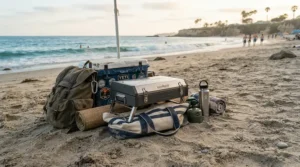
Problem to Solution: Five Windy-Beach Cooking Headaches
Problem 1: The flame keeps dying at low heat. Raise the burner to medium, tighten the panels, and reorient the stove. If it still happens, a push-button model like the Eureka Ignite Plus shortens relights.
Problem 2: Water takes forever to boil. Wind is stealing heat. Use lids, pre-warm water in the sun, or pick a higher-BTU stove such as the Camp Chef Everest 2X. The Jetboil Genesis Basecamp system includes a pot with an integrated heat exchanger that improves efficiency, according to BetterTrail.
Problem 3: Sand clogs ignition and burners. Never set the stove directly on sand. Cover it during transport, and brush ports clean after trips.
Problem 4: Screens rattle or blow over. Secure panels with clips, weight a freestanding screen, or switch to a lid-integrated design like the Camp Chef Everest 2X.
Problem 5: Salt corrodes metal. Wipe down after each trip, dry thoroughly, and store the stove indoors. The Coleman Cascade Classic and others with removable grates make cleaning easier.
Real-World Scenarios: Matching Stoves to Beach Trips
The weekend couple. Two nights a season, a $100 budget, mild coastal breeze. The Coleman Classic Propane 2-Burner covers breakfast and dinner, and a few spare bottles keep it simple. Add a cooler as a windbreak and you’re set.
The family of five. A four-day beach week with daily full meals. The Camp Chef Everest 2X, run from a bulk tank via hose adapter, gives enough output to boil pasta and sear burgers at the same time. The up-front cost is higher, but fuel per meal drops with a bulk tank.
The surf crew in a van. Space is tight and trips are frequent. The Jetboil Genesis Basecamp packs small, simmers beautifully, and handles most meals, provided the crew carries a tarp or windbreak. The Eureka Ignite Plus is a cheaper alternative if you can find one in stock.
Value over time. Total cost of ownership includes fuel, replacement parts, and your patience. A budget stove with slow boils burns more fuel when wind is strong. A pricier model that boils faster may recover its cost across a season of weekends.
Two Burner Propane Stove vs Alternatives: Single-Burner, Butane, and Open Fire
Single-burner canister stoves are compact, but a two-burner lets you boil pasta while sautéing sauce, which saves time and fuel when wind is slowing everything down. Butane tabletop stoves are tidy for picnics, though their higher boiling point makes them weaker in cool shoreline air. Open fires are atmospheric but hard to control in wind, and many beaches and campgrounds restrict them.
For most groups, a two burner propane stove with wind guards for windy beaches hits the sweet spot: multitasking, reliable fuel, and flexible protection. The honest caveat is size and weight. Models like the Camp Chef Explorer are heavy, so if you’re hiking in, choose a smaller system.
Safety and Regulations: Carbon Monoxide, Recalls, and Fire Rules
Stoves are safe when used correctly, so three rules matter most.
First, never cook or heat inside tents, campers, or vehicles. The U.S. Consumer Product Safety Commission warns that carbon monoxide from camping stoves, lanterns, and heaters kills people every year, and the symptoms can look like a cold or flu. A windy beach tempts people to cook under a tarp or in a vestibule; resist.
Second, check for recalls. The 2020 Camp Chef recall covered roughly 20,600 stoves, including certain Camp Chef Everest 2X units, over a regulator defect that could leak gas, with 26 reports of leaks at the time. The remedy was a free regulator replacement kit.
Third, follow local rules. Fire restrictions vary by park, seashore, and season, and some agencies require clearing flammable material around any stove. Check with the land manager before you go, and keep cylinders upright, outside windscreens, and away from dune grass.
FAQ
❓ Can you cook on a windy beach without a windscreen?
❓ How many BTUs do I need for beach cooking?
❓ Should I use 1 lb bottles or a 20 lb tank?
❓ Do I really need an igniter on a windy beach?
❓ How do I protect a camp stove from sand and salt?
Conclusion
Beach wind will never be your friend, but with the right gear it stops being your enemy. The best two burner propane stove with wind guards for windy beaches is the one that matches your crew, your budget, and your patience for setup.
For most campers, the Camp Chef Everest 2X is the strongest all-rounder: built-in screen, serious output, and fine simmer control. Budget buyers should look at the Coleman Classic Propane 2-Burner or Coleman Triton 2-Burner, while big groups will appreciate the Camp Chef Explorer. The Eureka Ignite Plus suits cooks with large pans, the Coleman Cascade Classic rewards patient simmering, and the Jetboil Genesis Basecamp wins on packability if you bring your own windbreak.
Whatever you choose, remember that technique matters as much as hardware: position the stove with its back to the wind, use lids, keep cylinders clear of screens, and never cook inside a tent. Prices change frequently, so check current price and availability before you buy.
Recommended for You
- Three Burner Camp Stove for Family Tailgating: 7 Best Picks 2026
- High Output Two Burner Stove for Cooking for Large Groups: 7 Best ’26
- Compact Two Burner Camp Stove for Small SUV Trunk: 7 Top Picks 2026
Disclaimer: This article contains affiliate links. As an Amazon Associate, I earn from qualifying purchases. If you purchase products through these links, we may earn a small commission at no additional cost to you.
✨ Found this helpful? Share it with your friends! 💬🤗
