
In This Article
A high output two burner stove for cooking for large groups is a portable propane cooker with two independent burners, rated far above ordinary camp-stove power (think 20,000 to 75,000 BTU each). It sits on a frame that can hold oversized stockpots and runs on a regulator matched to those burners, so the flame stays steady from the first boil to the last pancake.
Here’s the problem it solves. A single burner serves a crowd the way a one-lane bridge serves rush hour: everything queues. Meanwhile your family reunion, scout campout, or tailgate wants chili, coffee water, and breakfast sausages at roughly the same moment. Heat is counted in British thermal units, the energy needed to warm one pound of water by one degree Fahrenheit. The per-burner figure decides whether that giant pot of pasta water boils before your guests start circling the cooler.
This guide compares seven real stoves, from a sub-$100 cast iron roarer to a freestanding 60,000 BTU workhorse. Expect the translation your product listing skips: what each spec means in practice, a boil-time calculation you can sanity-check, and a hard look at stockpot stability and regulated propane flow. A decision framework by group size follows. Everything below comes from published specs and aggregated reviewer sentiment, not claimed hands-on testing. Prices appear as ranges because they change constantly, so check the current price before you buy.
Quick Comparison: 7 Stoves at a Glance
Before the deep dive, here’s the whole field on one screen. “BTU per burner” is the column to read first.
| Stove | Total BTU | BTU per Burner | Best For |
|---|---|---|---|
| Camp Chef Explorer | 60,000 | 30,000 | Freestanding all-rounder for 12-20 people |
| Camp Chef Everest 2X | 40,000 | 20,000 | Wind-tough car camping for 5-10 people |
| Gas One Propane Double Burner | 150,000 | 75,000 | Fastest big-pot boils per dollar |
| Bayou Classic DB375 | 110,000 | 55,000 | Very large boil and fry pots |
| ROVSUN 2 Burner 150,000 BTU | 150,000 | 75,000 | Budget raw heat for backyard cooks |
| Coleman Triton 2-Burner | 22,000 | 11,000 | Light, easy stove for 4-8 people |
| Coleman Classic 2-Burner | 20,000 | 10,000 | Simple, proven entry-level cooking |
The pattern jumps out fast. The Gas One Propane Double Burner and ROVSUN 2 Burner 150,000 BTU offer the most heat per dollar, but it comes from cast iron jet burners with coarse control. The Camp Chef Explorer gives you 60,000 BTU on appliance-style dials plus a windscreen. For crowds of 12 or more cooking real meals, not just boiling water, the Camp Chef Explorer and Bayou Classic DB375 make the most sense. The Coleman Triton 2-Burner and Coleman Classic 2-Burner are honest supporting acts for smaller groups.
💬 Just one click — help others make better buying decisions too!😊
Top 7 High Output Two Burner Stove for Cooking for Large Groups: Expert Analysis
1. Camp Chef Explorer — freestanding 60,000 BTU for 20-person pots
The Camp Chef Explorer is the stove people picture when they say “crowd cooker,” and the legs are the reason. It stands on its own at roughly 29 inches, so you cook at counter height instead of crouching over a picnic table.
Two 30,000 BTU cast-aluminum burners (60,000 BTU total) sit under a 14-by-32-inch cooking surface of about 448 square inches, wrapped in a three-sided windscreen. In practice, a large stockpot and a 12-inch skillet fit side by side, and gusts won’t steal the flame. The included regulator and 3-foot hose also spare you a hardware scavenger hunt.
Based on the spec comparison, this is the sweet spot for 12 to 20 people. CleverHiker’s review judges it capable of a massive pot of chili or pasta for around 20 campers, which matches the burner math. It also accepts Camp Chef’s 14-inch accessories, so the same frame can turn into a griddle line for pancake mornings.
Reviewers consistently praise the power and the windscreen. Common complaints are weight (retail listings put it near 30 pounds, with some listings higher) and a big footprint.
Pros:
- ✅ Counter-height, freestanding setup with leveling legs
- ✅ 30,000 BTU per burner on real dials
- ✅ Regulator and hose included in the box
Cons:
- ❌ Heavy and bulky to haul and store
- ❌ Thirsty on propane when run wide open
Expect roughly the $150-$200 range at the time of research. Verdict: the best overall value if you regularly cook for a dozen or more.
2. Camp Chef Everest 2X — fastest boils in a stiff breeze
The Camp Chef Everest 2X trades the Explorer’s size for sprint speed. Each burner delivers 20,000 BTU (40,000 total) under a 215-square-inch top, with matchless ignition and folding wind shields that latch to the body.
Independent testers measured about 3 minutes 21 seconds on average to boil a liter at OutdoorGearLab, and 3:49 at CleverHiker. OutdoorGearLab’s wind test came in nearly identical. The shields do real work, so a breezy picnic site won’t double your boil time.
What most buyers overlook is the cooking surface. It comfortably handles two large pans or a mid-size stockpot, but it isn’t a home for turkey-fryer-class pots. Think of it as the stove for 5 to 10 people at a campsite table.
Reviews are strongly positive on power, simmer control, and build. Recurring downsides are heavy propane consumption, a one-year warranty, and the occasional report of a finicky ignition. Keep a lighter in the cooking kit.
Pros:
- ✅ Class-leading boil times, even with wind
- ✅ Solid windscreen and strong all-metal build
- ✅ Good low-heat control for simmering
Cons:
- ❌ Burns through fuel faster than weaker stoves
- ❌ Only a one-year warranty
Expect roughly the $200-$250 range. Verdict: the best pick for windy sites and mid-size crowds, but not the cheapest per BTU.
3. Gas One Propane Double Burner — 150,000 BTU for sub-$100 money
If raw heat per dollar is your religion, the Gas One Propane Double Burner is the church. Listings show 150,000 BTU total (75,000 per burner), cast iron construction, an adjustable 0-5 PSI regulator, a 4-foot hose, and removable legs, at roughly 27 pounds.
Those are high-pressure jet burners, the type used for crawfish pots and homebrew kettles. The adjustable regulator is the key feature, because it lets you dial that fury down instead of living at “inferno.”
On paper, this is the fastest way to bring a very large pot to a boil on a modest budget. The trade-off is finesse: coarse low-end control means delicate sauces are harder, and thin-bottomed pots can scorch if you wander off. Gas One sells a windscreen version separately, so factor in wind protection or bring your own.
Roundups put the owner rating around 4.6 out of 5, with one practical gripe about the legs being fiddly to reattach with cold hands.
Pros:
- ✅ Enormous heat for the price
- ✅ Adjustable regulator tames the flame
- ✅ Removable, height-adjustable legs
Cons:
- ❌ Base model lacks built-in wind panels
- ❌ Coarse control for gentle simmering
Expect the under-$100 range. Verdict: a standout for boil-heavy cooking, as long as you supply the windscreen and the patience.
4. Bayou Classic DB375 — built for pots up to 62 quarts
The Bayou Classic DB375 comes from the world of seafood boils, and it shows. The listing describes two 6-inch cast iron burners totaling 110,000 BTU, a 14-by-28¾-inch cooking surface, and locking extension legs that raise it to 25 inches.
A 10 psi regulator with dual brass control valves and dual 36-inch braided hoses gives each burner its own valve. Slide-and-lock side shelves hold your seasoning and spoons. Bayou rates the stove for pots up to 62 quarts, which dwarfs anything the compact stoves here can balance.
That extra capacity comes with a design logic: wide cast iron burners and a welded steel frame favor huge, heavy loads over portability. It’s a driveway or campsite tool, not a trunk-corner afterthought.
Verifiable review data is thin for this exact model, and one large retailer listed it as sold out. Availability varies, so confirm stock and specs before committing.
Pros:
- ✅ Rated for very large stockpots
- ✅ Independent brass valve per burner
- ✅ Braided hoses and side shelves included
Cons:
- ❌ Bulky, not a casual travel stove
- ❌ Pricier than imports with similar BTU
Expect roughly the $200-$250 range. Verdict: the right call if giant boil pots are the main event.
5. ROVSUN 2 Burner 150,000 BTU — big-box budget heat
The ROVSUN 2 Burner 150,000 BTU targets the same buyer as the Gas One: someone who wants maximum jet-burner output without spending serious money. Listings advertise 150,000 BTU total (75,000 per burner), cast iron construction, and a high-pressure setup.
On the spec sheet it matches the Gas One Propane Double Burner almost point for point. The meaningful differences hide in the fine print: regulator rating, hose length, leg design, and warranty, all of which vary by listing and seller. Read those before you click.
This is also where honesty matters. Detailed, verifiable review data for this specific model was thin at the time of research, so the sentiment picture is less certain than for the Camp Chef stoves. A cheap 150,000 BTU rating tells you about potential, not about build tolerances.
Pros:
- ✅ Very high advertised BTU output
- ✅ Cast iron burners built for heavy pots
- ✅ Low entry price in the high-pressure class
Cons:
- ❌ Thin verifiable review history
- ❌ Regulator and hose details vary by listing
Expect roughly the $90-$120 range. Verdict: a reasonable gamble for backyard cooks, but compare listing details against the Gas One Propane Double Burner first.
6. Coleman Triton 2-Burner — lightest at about 5 pounds
The Coleman Triton 2-Burner is the honest “don’t overbuy” option. It delivers about 22,000 BTU total, ships with wind guards, and weighs roughly 5 pounds, light enough to hand to a teenager. A roundup site notes it holds 10-inch and 12-inch pans comfortably.
Let’s be straight: this is not a true high output stove. At around 11,000 BTU per burner, a big stockpot will take its time. Its real role is the second stove at a larger gathering, handling coffee water, sides, and a skillet while a stronger stove carries the main pot.
Where it shines is reliability. One roundup cites a rating near 4.7 out of 5 across more than 3,700 reviews, and Coleman’s coverage runs longer than Camp Chef’s one-year warranty.
Pros:
- ✅ Very light and quick to set up
- ✅ Wind guards and strong owner ratings
- ✅ Fits common 10-12 inch pans
Cons:
- ❌ Too gentle for oversized stockpots
- ❌ Not freestanding, so you need a table
Expect roughly the $100-$130 range. Verdict: great for groups of four to eight and as a sidekick stove, not a primary crowd cooker.
7. Coleman Classic 2-Burner — the old reliable
The Coleman Classic 2-Burner is the stove your uncle’s garage probably still holds. It offers two 10,000 BTU burners (20,000 total), WindBlock panels, and a removable chrome-plated grate, at about 11.6 pounds.
Coleman says a single 16.4-ounce cylinder lasts up to an hour with both burners on high. That figure is a handy reality check on fuel appetite. One long-term owner review reports bringing a quart of 50°F water to a boil in about three minutes, which is plenty quick for small pots and hopeless for twenty servings.
The owner-reported weak spot is the rigid regulator line: letting a heavy bottle dangle from it can stress the fitting. Support the cylinder instead.
Pros:
- ✅ Simple, proven, easy-to-control burners
- ✅ Wind panels adjust to pan size
- ✅ Strong aggregated owner ratings
Cons:
- ❌ Limited power for large pots
- ❌ Rigid hose needs a supported cylinder
Expect roughly the $80-$130 range. Verdict: a dependable entry stove, but not what this guide’s focus keyword is really after.
How to Choose a High Output Two Burner Stove for Cooking for Large Groups
Picking well takes six decisions, in this order.
- Count pots, not just people. A crowd usually needs one large stockpot plus one skillet or kettle running together. That’s the job two burners do, so confirm both can fit side by side.
- Read BTU per burner, not the total. A 150,000 BTU headline means 75,000 per burner. A 40,000 BTU stove with two 20,000 burners may suit your pot better than a lopsided design.
- Match the frame to the pot. Check the grate width and stand height against your biggest stockpot. Wide, low frames are steadier than tall, narrow ones.
- Insist on a matched regulator and hose. High-pressure jets and appliance-style burners need different regulators. Buy the set the maker supplies.
- Judge the wind protection. Built-in shields save fuel and frustration, especially at open campsites and tailgate lots.
- Weigh the haul. A 5-pound stove and a 30-pound stove aren’t the same trip. Be honest about where it lives between uses.
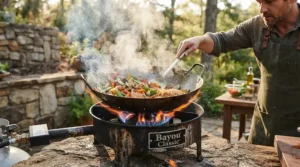
BTU per Burner: The Number That Decides Everything
BTU per burner is the gap between waiting politely and waiting forever. Unlike total BTU, it tells you how hard one pot can actually be pushed.
Two Burner Stove With High BTU Burners for Big Pots
A two burner stove with high BTU burners for big pots needs 30,000 BTU per burner at a minimum for stockpots in the 8-to-16-quart range. For 40-quart-plus boils, the 55,000-to-75,000 BTU jets on the Bayou Classic DB375, Gas One Propane Double Burner, and ROVSUN 2 Burner 150,000 BTU become genuinely useful. Below about 15,000 per burner, the Coleman Triton 2-Burner and Coleman Classic 2-Burner simply take longer.
Powerful Two Burner Propane Stove for Boiling Water Fast: The Math
A powerful two burner propane stove for boiling water fast is an easy claim to test with arithmetic. Five gallons of water weighs about 41.7 pounds, and heating it from 60°F to 212°F takes roughly 6,300 BTU actually absorbed by the water. Assume about 40% of the flame’s energy reaches the water (lid on, no wind). A 10,000 BTU burner then needs roughly 95 minutes, a 30,000 BTU burner about 32, and a 75,000 BTU burner about 13. These are back-of-envelope estimates, not lab measurements, but the ratios are the point.
| Stove | Weight | Burner / Regulator Notes | Price Range | Reported Rating | Best For |
|---|---|---|---|---|---|
| Camp Chef Explorer | ~30 lb | Cast aluminum, dials, regulator included | $150-$200 | 4.4+ (retail listings) | 12-20 people |
| Camp Chef Everest 2X | ~12 lb | Cast aluminum, matchless ignition | $200-$250 | ~4.6 (roundups) | Windy sites |
| Gas One Propane Double Burner | ~27 lb | Cast iron, adjustable 0-5 PSI | Under $100 | ~4.5-4.6 (roundups) | Fast big boils |
| Bayou Classic DB375 | Not verified | 6-inch cast iron, 10 psi, dual valves | $200-$250 | Few verifiable | 40-62 qt pots |
| ROVSUN 2 Burner 150,000 BTU | Not verified | Cast iron, high pressure | $90-$120 | Not verified | Budget backyard |
| Coleman Triton 2-Burner | ~5 lb | Wind guards, 10-12 in pans | $100-$130 | ~4.7 (roundups) | 4-8 people |
| Coleman Classic 2-Burner | ~11.6 lb | Two 10,000 BTU burners | $80-$130 | ~4.7 (retail) | Small groups |
Reading across the table, weight and control style track power. Heavier, higher-BTU stoves boil faster but ask more of your storage space and your attention. The Camp Chef Explorer and Camp Chef Everest 2X are the two with the most verifiable positive sentiment at this power level, while the cheapest 150,000 BTU stoves carry the most uncertainty.
Stockpot Stability: Keeping Big Pots Upright
Stockpot stability is the unglamorous spec that decides whether dinner survives. A 16-quart pot of water weighs over 33 pounds before the pot itself, and that mass sits high above the legs.
Three things govern stability. The first is grate width versus pot base: the pot’s footprint should land on the grate’s widest support, not tilt on one edge. The second is stand height. The Bayou Classic DB375 raises to 25 inches for tall pots, which is convenient for handling but raises the center of gravity. The third is leg splay and leveling. The Camp Chef Explorer has legs that level individually, which helps on gravel campsites, and wide-leg designs steady heavy loads.
Practical rules help. Keep pots no more than about three-quarters full, and choose wide-bottomed pots over tall skinny ones. Turn handles away from the second burner so they don’t heat up and invite a one-handed grab. The Coleman Triton 2-Burner and Coleman Classic 2-Burner are happiest with 10-to-12-inch pans, not stockpots. Unstable cooking surfaces also matter for kids and pets, so set the stove somewhere nobody walks past carrying drinks.
Regulated Propane Flow: The Hidden Spec
Regulated propane flow is why a stove lights the same way on a cold morning as on a warm afternoon. Tank pressure swings with temperature, and the regulator steps it down to a steady output the burner expects. For reference, a low-pressure appliance regulator typically delivers around 11 inches of water column (about 0.4 psi), while jet burners like the Gas One Propane Double Burner use adjustable 0-5 PSI regulators and the Bayou Classic DB375 pairs with a 10 psi unit.
The takeaway is simple: never mix and match. Low-pressure burners on a high-pressure regulator can overpressure the hose, and jet burners starved by a low-pressure regulator sputter and underperform. Use the regulator and hose supplied for that stove.
Flow can also sag at high draw. Pulling propane out faster than the cylinder can vaporize cools it and drops pressure, so a 150,000 BTU stove at full throttle can fade late in a long boil. A fuller cylinder, a warmer day, or backing off one burner helps.
Cylinder handling matters too. The propane industry’s portable cylinder safety guide recommends keeping ignition sources away while handling or transporting cylinders and securing them upright. It also says not to leave them in your vehicle. After connecting, check fittings for leaks (soapy water bubbles are the classic method) before lighting anything.
Two Burner Stove vs Alternatives: Where Each Option Wins
A two burner stove isn’t the only way to feed a crowd, so here’s how it stacks up.
| Option | Strength | Weakness | Best For |
|---|---|---|---|
| High output two burner stove | Two pots at once, flexible heat | Heavier than a single burner | Mixed menus for 8-20 |
| Single jet cooker (300,000+ BTU class) | Massive heat for giant boil pots | One pot, little finesse | Seafood boils, frying |
| Three burner stove | Extra cooking space | Larger footprint, more fuel | Events with 20+ people |
| Campfire and Dutch oven | Atmosphere, no stove needed | Slow, weather-dependent | Relaxed, small crowds |
The comparison clarifies the job. If your menu is one enormous boil, a single jet cooker wins on pure power. If you cook breakfast, a main, and sides, two independent burners are the efficient middle. A three burner setup only earns its bulk when two pots plus a griddle must run together at all times.
For most large-group cooks, a two burner high output stove hits the best balance of control, footprint, and fuel use. That’s why it’s the focus of this guide.
How to Set Up and Run Your Stove Like a Camp Kitchen Pro
A few habits make any of these stoves behave better, and most of them Amazon listings never mention.
- Level first, light second. Set the stove on firm, flat ground, then verify with a water-filled pot before the real load goes on.
- Orient for wind. Point the windscreen into the breeze and keep the cylinder on the downwind side, clear of the flame path.
- Leak-test every trip. Brush soapy water over the connections after attaching the regulator. Bubbles mean tighten or replace.
- Start the water first. The big pot is the slowest item, so light it before anything else. Stagger secondary pans after.
- Use lids. A lid cuts boil time dramatically and saves propane.
- Protect the hose. Keep it clear of burners and heat, and inspect it for cracking each season.
Common mistakes in the first 30 days: overfilling the pot, running one burner flat out while the other idles under a cold pan, and storing the cylinder inside a vehicle. Clean burner ports with a soft brush when flames turn yellow or uneven, and let cast iron cool before wiping it. Expert cooks plan the menu around burner timing, not just recipes.

Real-World Scenarios: Matching the Stove to Your Crowd
Scenario 1: The scout troop campout. Twenty hungry kids, three nights, one vehicle. Chili one night, pasta the next, pancakes in the morning. The Camp Chef Explorer fits: freestanding height, 60,000 BTU, and a griddle accessory for pancake duty. Budget is moderate and usage is several weekends a year.
Scenario 2: The backyard boil. Twelve relatives, a 40-quart pot, once or twice a year. The Bayou Classic DB375 or the Gas One Propane Double Burner will boil that pot while sides cook alongside. Cost sensitivity favors the Gas One Propane Double Burner, but pair it with a windscreen.
Scenario 3: The tailgate crew. Eight friends, six games per season, setup in a parking lot. The Camp Chef Everest 2X is quick and wind-tough, with 40,000 BTU that deals with burgers, chili, and coffee water in rotation.
Whatever the scenario, the stove is only half of safe group cooking. USDA’s food safety guidance for cooking for groups points out that cooks who are great at home don’t automatically know how to handle large quantities safely. A common rule from that guidance is discarding perishable leftovers that sat out at room temperature for two hours or more. Plan hot holding and cooling before the first burner is lit.
✨ Don’t Miss These Exclusive Deals!
🔍 Take your group cooking to the next level with these carefully selected stoves. Click on any highlighted item to check current pricing and availability. The right high output setup will help you serve every guest hot, on time, and stress-free!
Problem → Solution: Fixing the Five Most Common Headaches
Problem 1: The flame keeps blowing out. Turn the stove so the windscreen takes the wind, or add a freestanding panel. The Camp Chef Everest 2X and Camp Chef Explorer are built for this, while the base Gas One Propane Double Burner needs your help.
Problem 2: The pot feels tippy. Use a wide-bottomed pot, lower the fill level, and re-level the legs. Move to a stove with a wider footprint, like the Bayou Classic DB375, if you routinely push past 16 quarts.
Problem 3: The flame sputters or sags. Check that the regulator matches the burner, then check the cylinder. A nearly empty or iced-up tank starves flow. Swap in a fuller cylinder or rest the stove for ten minutes.
Problem 4: The bottom of the pot scorches. High BTU burners punish thin pots. Turn the valve down, stir more often, and use thicker cookware. Pasta sauce and chili are the usual victims.
Problem 5: The cylinder dies mid-boil. Always carry a spare. As a reference, a standard 16.4-ounce cylinder lasts about an hour with both burners high on a 20,000 BTU stove like the Coleman Classic 2-Burner, so small bottles are a false economy for group cooking.
Long-Term Cost & Fuel Use: What Big BTUs Really Cost to Run
Total cost of ownership is the stove, the regulator and hose replacements over the years, and the propane you burn. Propane holds roughly 21,500 BTU per pound, so a 20-pound cylinder carries about 430,000 BTU of energy. Run wide open, that’s around seven hours on the 60,000 BTU Camp Chef Explorer and about three on a 150,000 BTU jet stove. Real cooking runs lower, and a lid on every pot stretches a tank further. Refill prices vary by retailer, so check locally.
Fuel appetite is a recurring reviewer theme for powerful stoves. OutdoorGearLab points out that high-output burners go through propane faster than lower-powered ones. That doesn’t mean a powerful burner wastes fuel: the energy needed to boil a pot is roughly fixed, so a stronger burner finishes sooner. The waste comes from leaving valves high with uncovered pots.
Maintenance is modest: brush the burners, replace cracked hoses, keep cast iron dry, and store cylinders outside. A one-year warranty (as on the Camp Chef Everest 2X) is worth weighing against a longer one on the Coleman Triton 2-Burner. Over several seasons, a $100 stove that survives often beats a $250 stove that never leaves the garage.
Safety Guide: Running High Output Burners Responsibly
Powerful burners deserve respect. The most serious risk isn’t the flame, it’s carbon monoxide. The Consumer Product Safety Commission warns that camping stoves, heaters, and lanterns should never be used inside tents, campers, or other enclosed shelters, because the exhaust can build up to dangerous levels. The symptoms (headache, dizziness, weakness, nausea, sleepiness, confusion) are easy to mistake for a cold or flu, which is part of the danger.
Other habits matter just as much:
- Operate only outdoors with open air around the stove, never in a garage or under a closed canopy.
- Keep flammables, dry grass, and paper well away from the burners.
- Never leave a lit stove unattended, and keep children and pets back.
- Let the stove cool before moving it, and shut the cylinder valve when finished.
- Keep a fire extinguisher or bucket of sand within reach.
Big-group cooking also means big-group distraction. Assign one person to the stove, and keep walkways clear of hoses.

FAQ
❓ Do high BTU burners burn through more propane than low BTU ones?
❓ Is a 150,000 BTU stove too much for backyard cooking?
❓ Can I swap the regulator that came with my stove for a different one?
❓ What size stockpot is safe on a portable two burner stove?
❓ Which stove is best if I only cook for a large group a few times a year?
Conclusion
Feeding a crowd is mostly a heat-and-stability problem, and the right high output two burner stove for cooking for large groups solves both. The Camp Chef Explorer is the best all-rounder for 12 to 20 people thanks to its 30,000 BTU burners, windscreen, and counter-height legs. The Camp Chef Everest 2X wins on wind and speed for mid-size crowds. If you boil enormous pots, the Bayou Classic DB375 is built for them, while the Gas One Propane Double Burner and ROVSUN 2 Burner 150,000 BTU deliver the cheapest raw heat, with the caveat that review evidence for the latter is thin. The Coleman Triton 2-Burner and Coleman Classic 2-Burner are lighter, lower-power companions for smaller groups.
Whatever you choose, remember the three checks that matter most: BTU per burner, a pot-friendly stand, and a regulator that matches the burners. Run it outdoors, test for leaks, and keep a spare cylinder. Prices change often, so check the current price before buying.
✨ Ready to feed your whole crowd without the wait?
🔥 Pick the stove that fits your group size, click through to check current pricing and availability, and get ready to serve hot food on time. Your next big cookout just got a lot easier!
Recommended for You
- Three Burner Camp Stove for Family Tailgating: 7 Best Picks 2026
- Compact Two Burner Camp Stove for Small SUV Trunk: 7 Top Picks 2026
- Two Burner Propane Stove With Wind Guards for Windy Beaches: 7 Best
Disclaimer: This article contains affiliate links. As an Amazon Associate, I earn from qualifying purchases. If you purchase products through these links, we may earn a small commission at no additional cost to you.
✨ Found this helpful? Share it with your friends! 💬🤗
